
End-to-End AI Video Editing: Choosing the Right Pipeline for Your Source Material
Not all footage needs the same AI processing. Compare ClipMind's three pipeline flows — character-first-narrative, visual-segment, and ASR-only — to understand which approach matches your source material and editing goals.
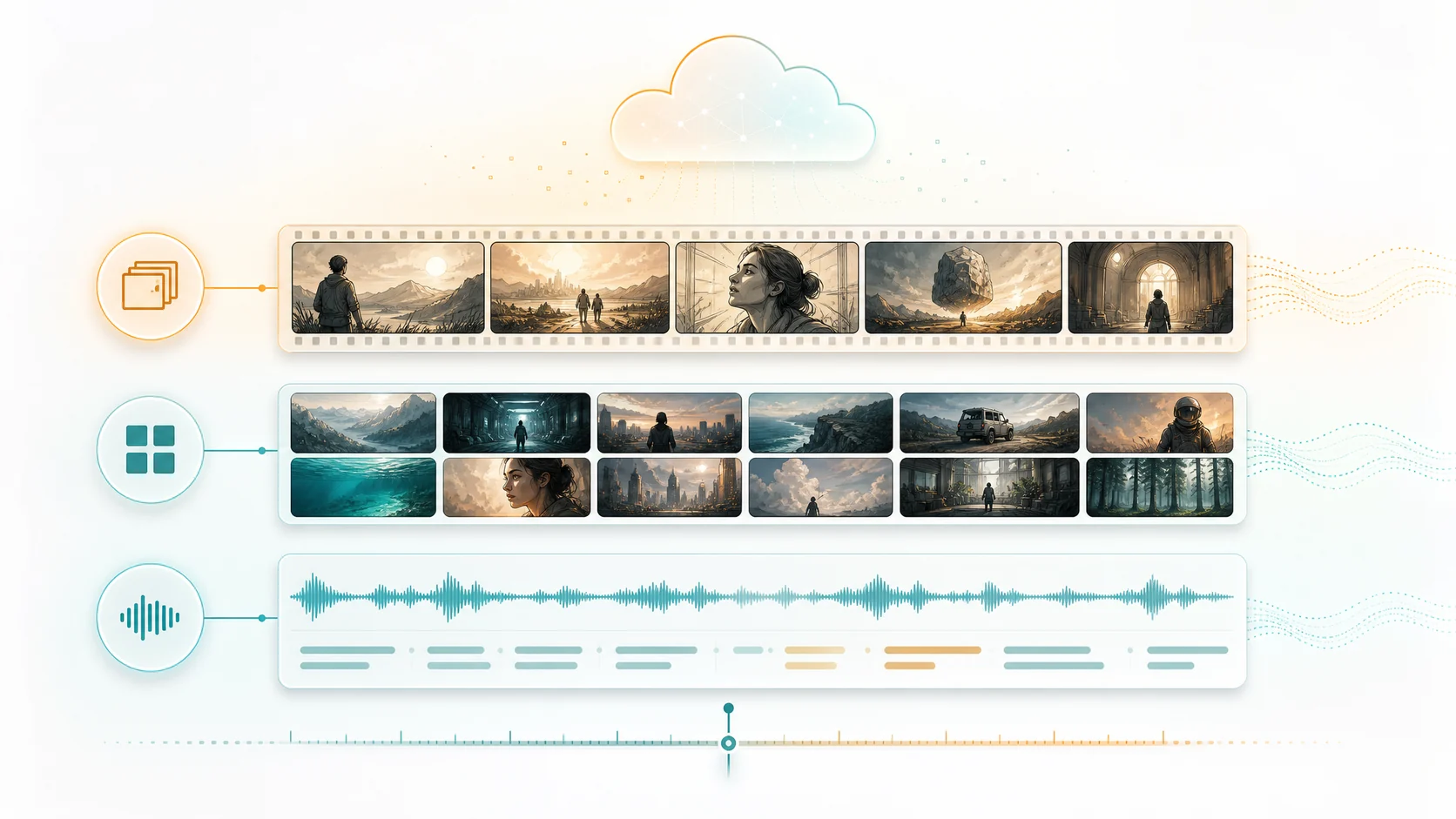
Raws footage comes in many forms. A film episode needs character tracking and narrative structure. A visual montage needs scene detection and shot selection. A podcast interview needs accurate transcription and speaker labeling. Running every video through the same AI pipeline wastes compute and produces irrelevant outputs. ClipMind offers three distinct pipeline flows — each optimized for a different type of source material. Choosing the right one is the first editing decision.
1. Character-first-narrative pipeline: for story-driven content
This is the full pipeline designed for films, series episodes, documentaries, and any content where characters, plot, and narrative arcs matter. It runs scene detection, ASR with speaker diarization, entity detection, visual embedding, HDBSCAN clustering, and narrative composition. The output is a rich reverse script that includes character identity maps, scene-by-scene story beats, dialogue attribution, and suggested groupings.
- Best for: films, TV series, documentaries, story recaps, multi-character content.
- Includes: scene detection, ASR, speaker diarization, entity clustering, narrative composition.
- Produces: a reverse script with character library, scene summaries, and narrative structure.
- Processing cost: higher due to entity clustering and embedding steps.
2. Visual-segment pipeline: for montages and visual content
This pipeline skips the entity clustering step and focuses on scene detection, ASR, and narrative composition. It is designed for content where visual impact matters more than character identity — product showcases, travel montages, event highlights, and atmospheric edits. The reverse script still includes scene boundaries and descriptive summaries, but without the character identity layer.
- Best for: visual montages, product videos, travel footage, event recaps.
- Includes: scene detection, ASR, narrative composition (no entity clustering).
- Produces: scene boundaries, transcripts, and scene-by-scene visual summaries.
- Processing cost: lower than character-first, faster turnaround.
3. ASR-only pipeline: for dialogue-dense content
The lightest pipeline runs speech recognition with speaker diarization, skipping both scene detection and entity clustering. It is ideal for content where the transcript is the primary editing input — podcast episodes, interview recordings, lecture captures, meeting archives, and voice memos. The output is a time-aligned transcript with speaker labels, suitable for text-based editing and dialogue extraction.
- Best for: podcasts, interviews, lectures, meetings, voice-heavy content.
- Includes: ASR with speaker diarization only.
- Produces: time-aligned transcript with speaker labels.
- Processing cost: lowest, fastest turnaround.
4. How pipeline choice affects editing output
The pipeline you choose shapes what the script planner agent can do in the editing phase. With a character-first reverse script, the agent can filter by character appearances, build character arcs, and generate character-focused edits. With a visual-segment output, the agent works with scene summaries and visual descriptions. With ASR-only, the agent relies on transcript search and speaker-based filtering. Choose the pipeline that produces the information your edit needs.
5. Mixed pipelines: different footage in the same project
A single project can contain videos processed through different pipelines. For example, you might run the main film footage through character-first-narrative, add B-roll through visual-segment, and include an interview through ASR-only. The project-level identity library updates as new footage is added, so characters identified in earlier runs are recognized in later uploads — even if those later uploads use a different pipeline.
6. Pipeline selection as a cost and time decision
Pipeline choice is not just about output quality — it affects processing time and credit consumption. Character-first-narrative uses the most compute due to embedding generation and clustering. Visual-segment is faster and cheaper. ASR-only is the quickest and most economical. For projects with tight deadlines or limited credits, choose the pipeline that delivers the minimum information needed for the edit — you can always run a deeper pipeline on specific footage later.
- Character-first: highest quality, highest cost, longest processing time.
- Visual-segment: balanced quality and cost for visual-first projects.
- ASR-only: fastest and cheapest for transcript-focused work.
FAQ
Can I change the pipeline after processing starts?
Processing cannot be changed mid-run, but you can reprocess footage through a different pipeline. The project-level identity library preserves clustering results from previous runs, so reprocessing through a deeper pipeline builds on existing data rather than starting from scratch.
What happens if I run the wrong pipeline?
Running ASR-only on a film meant for story recaps will produce a transcript but no scene structure or character maps — the agent will have less context for editing. You can reprocess through character-first-narrative to get the full reverse script.
How do I estimate processing time for each pipeline?
Processing time scales with video duration. ASR-only is roughly 1x real-time. Visual-segment adds scene detection overhead, approximately 1.5x to 2x real-time. Character-first-narrative adds embedding and clustering, taking 2x to 3x real-time depending on scene count and face density.
Can I mix pipelines across episodes of the same series?
Yes. Run the first episode through character-first-narrative to establish the identity library, then run subsequent episodes through the same pipeline to expand it. For episodes that are dialogue-only, ASR-only is fine — the existing identity library persists.