
AI Stop Motion Animation Service: Modern Tools for Frame-by-Frame Video Creators
AI-powered stop motion animation services are making frame-by-frame video creation faster and more accessible for independent creators, marketing teams, and educational content producers.
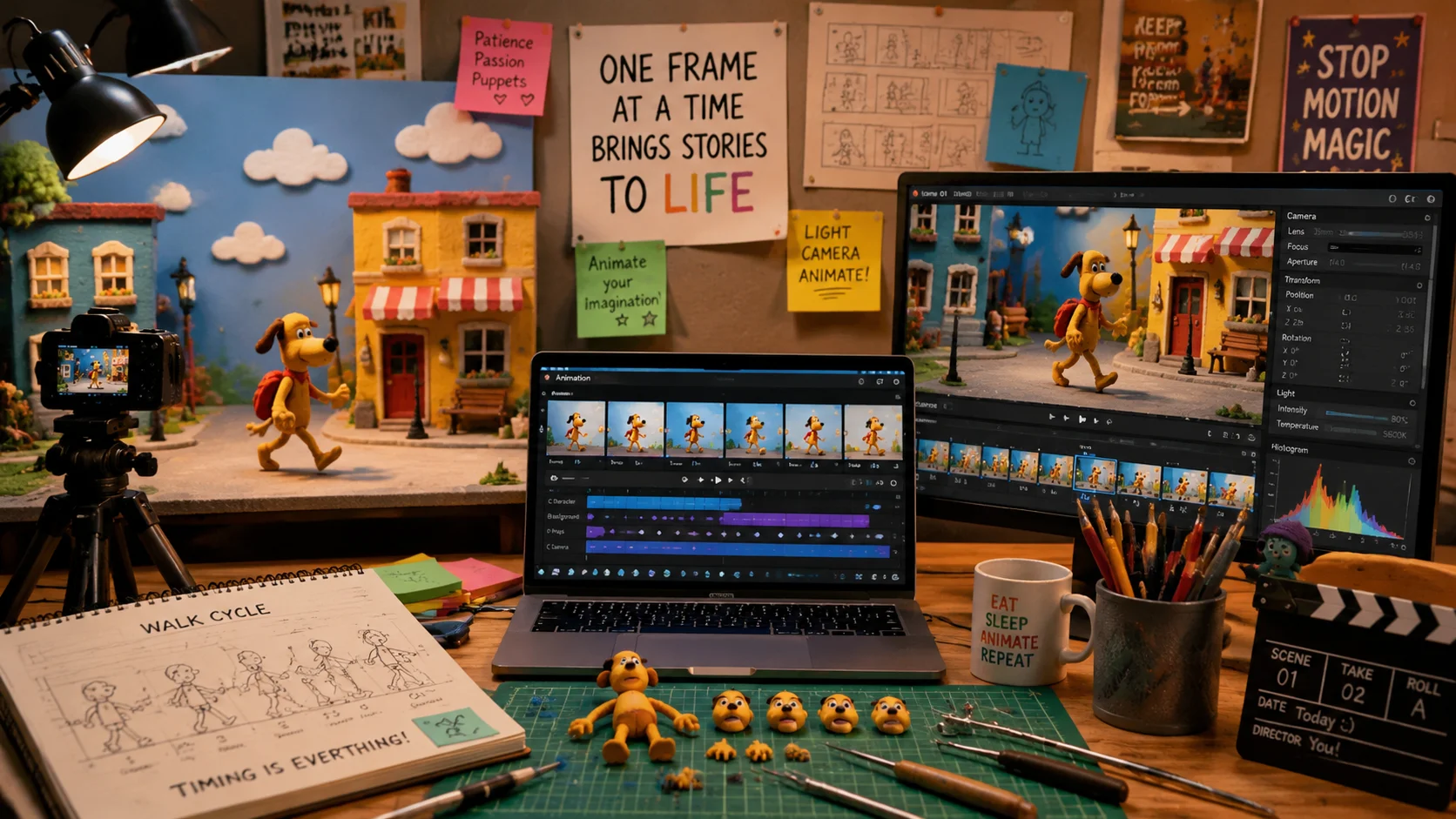
Stop motion animation has a unique charm that no other animation style can replicate. The tactile, slightly imperfect movement of real objects captured frame by frame creates a sense of craft and physical presence that digital animation often lacks. But traditional stop motion is also one of the most labor-intensive forms of video production. A single minute of animation at 12 frames per second requires 720 individual frames, each one needing precise object positioning, lighting consistency, and focus control. AI stop motion animation services are now bridging this gap, automating the repetitive parts of stop motion production while preserving the handcrafted look that makes the medium special.
1. The traditional stop motion bottleneck
Classic stop motion workflows involve a camera, physical objects or puppets, a controlled lighting setup, and enormous patience. Between each frame, the animator adjusts the subject, checks focus, and captures the next image. A typical animator might produce 5-10 seconds of usable animation in a full workday. Post-production adds frame stabilization, flicker removal, dust cleanup, exposure matching, and sometimes rotoscoping for rig removal. For a three-minute short film, this adds up to weeks or months of production time.
- A single animator produces roughly 5-10 seconds per day.
- Flicker, exposure drift, and dust are common frame-to-frame issues.
- Post-production cleanup can take as long as the animation itself.
2. Where AI fits into the stop motion pipeline
AI stop motion animation services target the most time-consuming parts of the workflow. Frame consistency tools use AI to detect and correct exposure shifts, color temperature changes, and minor lighting variations between frames. Flicker removal algorithms analyze sequences to smooth brightness fluctuations that come from slight lighting changes. Object detection can flag when a prop or puppet has moved unintentionally between frames. AI-assisted onion skinning can generate more accurate ghost overlays that show the animator exactly where the next position should be.
3. AI frame interpolation for smoother motion
One of the most practical AI features for stop motion is frame interpolation. Instead of shooting at 24 frames per second, an animator can shoot at 8 or 12 frames per second and let AI generate the intermediate frames. The AI analyzes the motion between two real frames and synthesizes a smooth transition. This does not replace the need for careful keyframe positioning, but it can turn a slightly choppy sequence into fluid motion without requiring double the shooting time. The best results come when the AI interpolation is used selectively on scenes that benefit from smoothness rather than applied uniformly across the entire project.
- AI interpolation can turn 12 fps source footage into 24 fps output.
- Selective use on specific scenes produces better results than global application.
- Interpolation works best when the animator's keyframes are already well-spaced.
4. Automated rig removal and cleanup
Professional stop motion often uses support rigs to hold puppets or objects in mid-air positions. Traditionally, removing these rigs requires frame-by-frame rotoscoping in compositing software, a process that can take hours for even a short sequence. AI tools can now detect support rigs, match the background from adjacent clean frames, and remove rigs automatically. The results still need human review for edge cases, but the bulk of the cleanup work is handled by the AI, freeing the artist to focus on creative decisions rather than repetitive masking.
5. Making stop motion viable for marketing content
Stop motion has always had strong appeal for advertising: it stands out, it feels authentic, and it captures attention in a scroll-heavy media environment. But the production time and cost have historically limited it to high-budget campaigns. AI stop motion services are changing this equation. A marketing team can now produce a 15-second stop motion social ad with AI-assisted shooting, cleanup, and interpolation in a fraction of the time and budget that a traditional stop motion production would require. The look remains handcrafted, but the production timeline becomes manageable for marketing calendars.
- AI reduces stop motion production time by 50-70% for short-form content.
- Social media ads benefit from the distinctive visual appeal of stop motion.
- Brands can test stop motion concepts without committing to full-scale production.
6. Choosing an AI stop motion animation service
When evaluating AI stop motion tools, consider which part of your workflow consumes the most time. If flicker and exposure drift are your main problem, look for strong frame consistency features. If you want smoother motion without shooting more frames, prioritize interpolation quality. If rig removal is your bottleneck, focus on tools with proven background reconstruction. Also consider whether the service works as a standalone application or integrates with your existing stop motion capture software and video editor. A service that requires exporting and reimporting files between multiple tools may add friction that offsets the AI time savings.
FAQ
Can AI create stop motion animation without any physical objects?
Some AI tools can generate stop motion-style animation from text prompts or video input, but these produce a simulated look rather than true frame-by-frame animation of physical objects. For authentic stop motion, AI is best used as an assistance tool for real-world capture and post-production.
What frame rate should I shoot for AI-assisted stop motion?
Shooting at 12 fps and using AI interpolation to reach 24 fps is a common and effective workflow. This gives the AI enough real frames to analyze while cutting the shooting workload in half.
Does AI stop motion work for claymation and puppet animation?
Yes. AI frame consistency, flicker removal, and interpolation work across all physical stop motion styles. Rig removal is especially useful for puppet animation where support armatures need to be removed from final frames.