
AI Radio Ad Script Generator: Write Commercial Scripts That Convert in Minutes
An AI radio ad script generator helps marketers, small business owners, and agencies produce radio-ready commercial scripts faster, with proper timing, tone, and call-to-action structure built in.
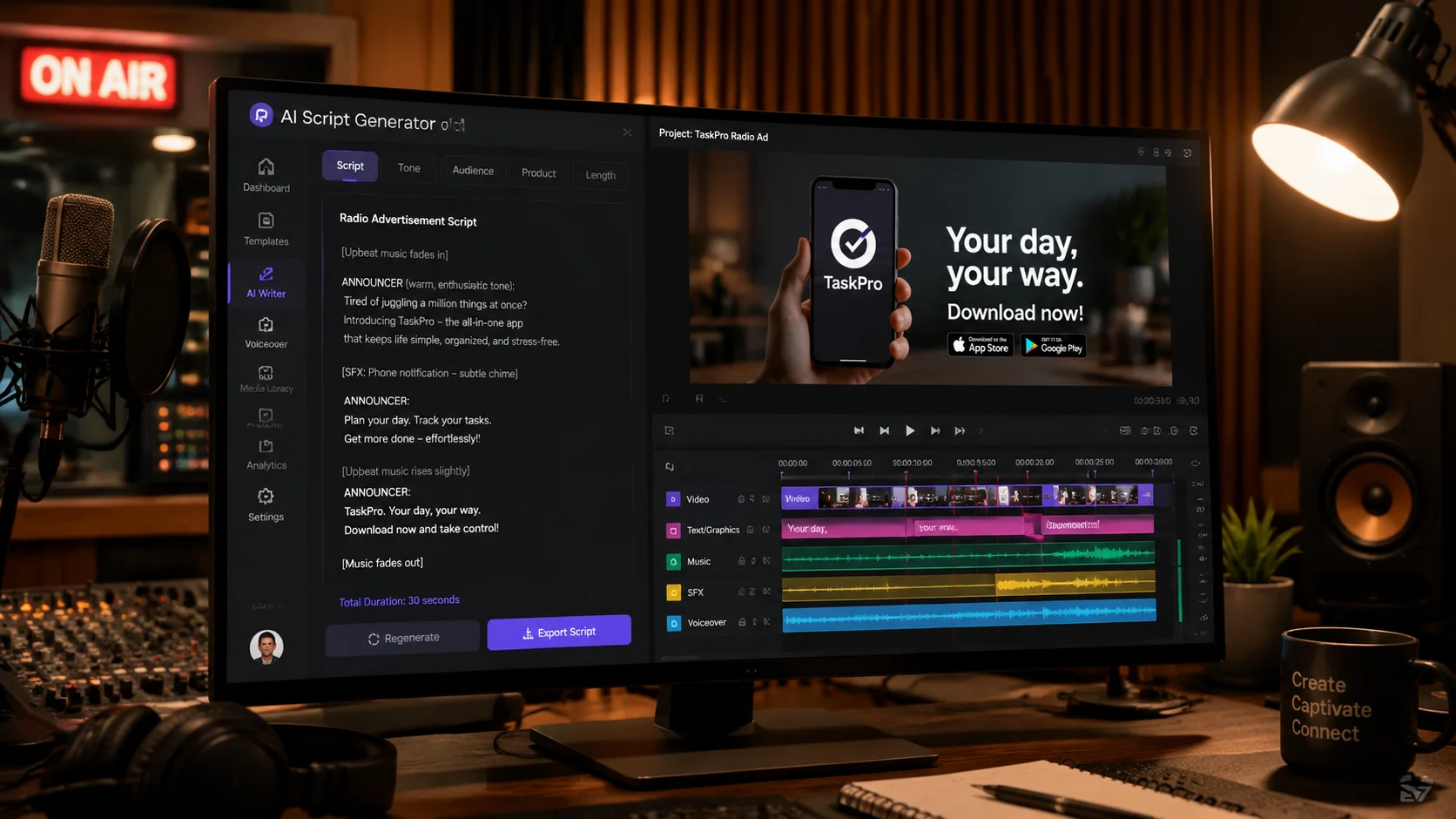
Writing a radio ad script looks simple on the surface. Thirty or sixty seconds, a few sentences, a call to action. But anyone who has written radio copy knows the hidden complexity. Every word competes with the clock. The tone must match the brand and the station format. The message must be clear on first listen because nobody rewinds a radio ad. Pacing, pauses, background sound, and the voice talent delivery all shape whether the ad lands or gets tuned out. An AI radio ad script generator does not replace a creative copywriter, but it dramatically accelerates the drafting process by handling timing calculations, format templates, and structural checks that normally require multiple revision rounds.
1. Why radio ad writing is harder than it looks
Radio is a linear, one-chance medium. Unlike a web page or a social post, the listener cannot scroll back. If a key detail is buried at second 27 of a 30-second spot, it will be missed. If the opening three seconds do not grab attention, the rest does not matter. If the call to action is unclear or rushed, the entire buy is wasted. These constraints mean that radio scripts need more discipline than almost any other ad format.
- Radio listeners make a stay-or-go decision within the first 3-5 seconds.
- A 30-second script typically holds 75-85 words at natural pacing.
- Every second of audio from voice, music, or effects counts against the total.
2. How an AI radio ad script generator works
An AI radio ad script generator takes inputs such as the product, target audience, offer, station format, and desired length, then produces a structured script draft. The generator calculates word count against timing, suggests where music beds and sound effects should enter and exit, flags sections that may be too dense for natural delivery, and ensures the call to action is positioned correctly in the time window. The output is not a final script, but a production-ready draft that a copywriter or producer can refine instead of starting from a blank page.
3. The structure that makes radio scripts work
Effective radio scripts follow a proven architecture. The hook opens with a question, sound, or statement that breaks through the listener's attention filter. The problem statement establishes relevance within five to eight seconds. The solution introduces the product or service as the answer. The proof point provides a reason to believe. The call to action gives clear next steps. Most scripts that fail do so because they spend too long on setup and rush the payoff. An AI script generator enforces this structure automatically.
- Hook: break attention in the first 3 seconds.
- Problem: establish relevance within 8 seconds.
- Solution: introduce the offer clearly.
- Proof: provide one concrete reason to trust.
- Call to action: give one clear next step with repetition.
4. Matching tone to station and audience
A script written for a news-talk station should not sound like one written for a Top 40 station. The pace, vocabulary, energy level, and even the use of music and effects differ by format. A financial services ad on an AM talk station might use a single narrator with subtle background music and a measured, trustworthy tone. A quick-service restaurant ad on a CHR station might use multiple voices, high-energy music, and sound effects that match the station's pace. An AI generator can be instructed to produce variants for different formats from the same core message.
5. Writing for voice talent delivery
A script that reads well silently may sound awkward when spoken. Good radio copy uses conversational sentence structures, avoids tongue-twisting consonant clusters, and leaves breathing room for the voice talent. Numbers, URLs, and phone numbers need special treatment: they should be written out phonetically in the production notes and repeated at least twice if they are critical. An AI radio ad script generator can flag tongue-twister phrases, mark breathing points, and format numbers for clean delivery.
- Write for the ear, not the eye. Read scripts aloud before finalizing.
- Avoid consecutive words that start with the same consonant.
- Repeat phone numbers and URLs at least twice in the script.
6. From script draft to finished audio
Once the AI generates a script draft, the production workflow typically moves to table read, revision, voice recording, sound design, and mixing. Having a well-structured draft at the start means that the table read identifies creative refinements rather than structural problems. The creative team spends its energy on performance, music selection, and effects that enhance the message, rather than fixing timing and format issues that could have been caught at the script stage.
FAQ
Can AI replace a professional radio copywriter?
AI accelerates drafting and handles structural checks, but creative judgment about brand voice, humor, cultural context, and emotional resonance still requires a human writer. The best results come from AI-assisted drafts refined by experienced copywriters.
How long does it take to generate a radio ad script with AI?
Most AI radio ad script generators produce a structured draft in under a minute. The human review and revision process typically takes 15-30 minutes per script, compared to several hours when starting from scratch.
What length radio ads can an AI generator handle?
Standard formats include 15-second, 30-second, and 60-second spots. Most generators can also handle 10-second station promos and 90-second long-form ads for podcast and streaming platforms.