
Agentic AI In Video Editing: From Hype To Practical Workflow
2026 is being called the year of agentic AI. But what does agentic actually mean for video editing? Here is how to apply the agent paradigm to real production workflows without falling for the hype.
Every major AI company is now talking about agents: autonomous systems that complete multi-step tasks without constant human input. Google, OpenAI, and Anthropic all positioned 2026 as the year of agentic AI. For video editing, the agent concept is appealing: upload footage, describe the desired output, and let the system produce a finished edit. The reality is more nuanced. Agents are powerful but not omniscient. The best workflows combine agent speed with human direction.
1. What makes a tool agentic
An agent is not just a model. It is a system that can take a goal, break it into steps, execute those steps, and adjust based on results. In video editing, an agent might ingest footage, detect scenes, identify key moments, assemble a timeline, sync audio, and propose an export. Each step uses different capabilities, but the agent orchestrates them toward a goal.
- Agents set goals and decompose them into tasks.
- Agents execute tasks and monitor progress.
- Agents adapt when tasks fail or produce unexpected results.
2. Where agentic workflows shine in video
Agentic workflows excel at the tedious parts of video production: initial ingest, scene detection, dialogue extraction, and first-pass selection. These are bounded tasks with clear success criteria. The agent watches, tags, and organizes. The human then reviews the organized output and makes creative decisions. The agent accelerates the preparatory work that used to take hours.
3. Where agents still need human direction
Agents struggle with the parts of editing that require taste, context, and judgment. They cannot reliably assess emotional pacing, brand alignment, or narrative arc. They do not know when a cut feels right or when a moment needs to breathe. These decisions remain human responsibilities. The agent proposes; the human decides.
4. The checkpoint model for agentic workflows
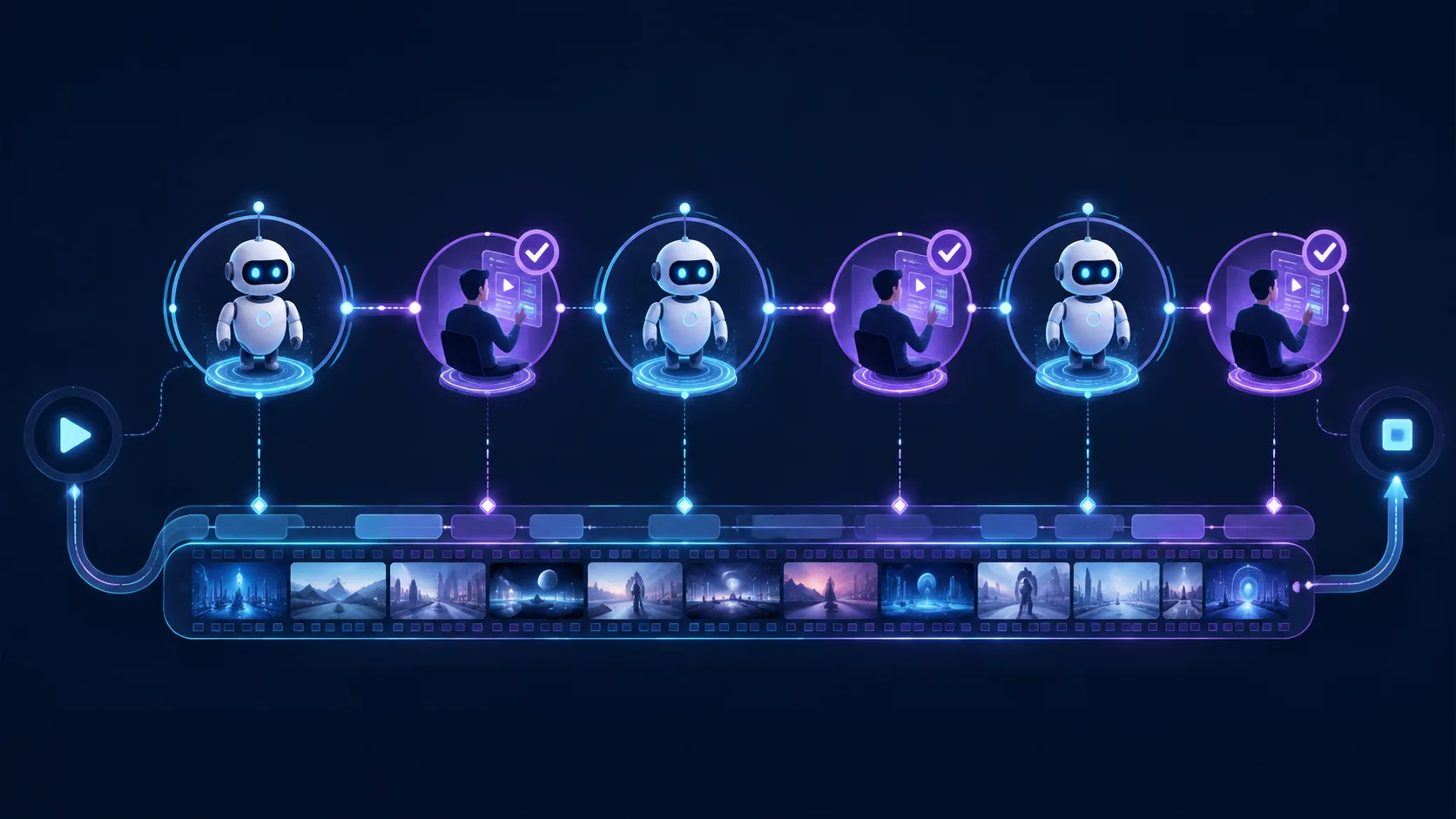
The most reliable agentic workflows insert human checkpoints between agent phases. After ingest and understanding, the human reviews the reverse script. After assembly, the human adjusts the timeline. After narration sync, the human approves the final output. Each checkpoint catches errors before they compound. The agent does the heavy lifting between checkpoints.
5. Avoiding the agent sprawl problem
Enterprise teams are discovering a new problem: too many agents, each with its own context, tools, and failure modes. This agent sprawl creates management overhead and security risks. For video workflows, prefer integrated agentic systems over a patchwork of specialized agents. One agent that understands the full pipeline is easier to manage than five agents that each handle one step.
6. The practical path forward
Start with bounded agent tasks: understanding, tagging, initial selection. Measure the time saved and the errors introduced. Add checkpoints at every judgment point. Expand agent responsibility only as reliability is proven. Agentic AI is genuinely useful, but it is not a substitute for human creative direction in video production.
FAQ
Is agentic AI ready for production video editing?
For preparatory tasks like understanding and selection, yes. For end-to-end autonomous editing, no. The technology works best when agents accelerate tedious work and humans retain creative control.
How do I evaluate agentic video tools?
Test on real projects. Measure both time saved and errors introduced. Check whether the tool keeps humans in the loop at judgment points. Verify that agent decisions are transparent and auditable.
What is the biggest risk with agentic workflows?
Over-trusting the agent. Agents are confident but not always correct. Without human checkpoints, small errors compound into unusable outputs. The safest approach is agent-accelerated, human-directed work.